S corp filingWhat these pages will not promise.
How a page is held, what the work refuses, and who publishes the address.
See the stop.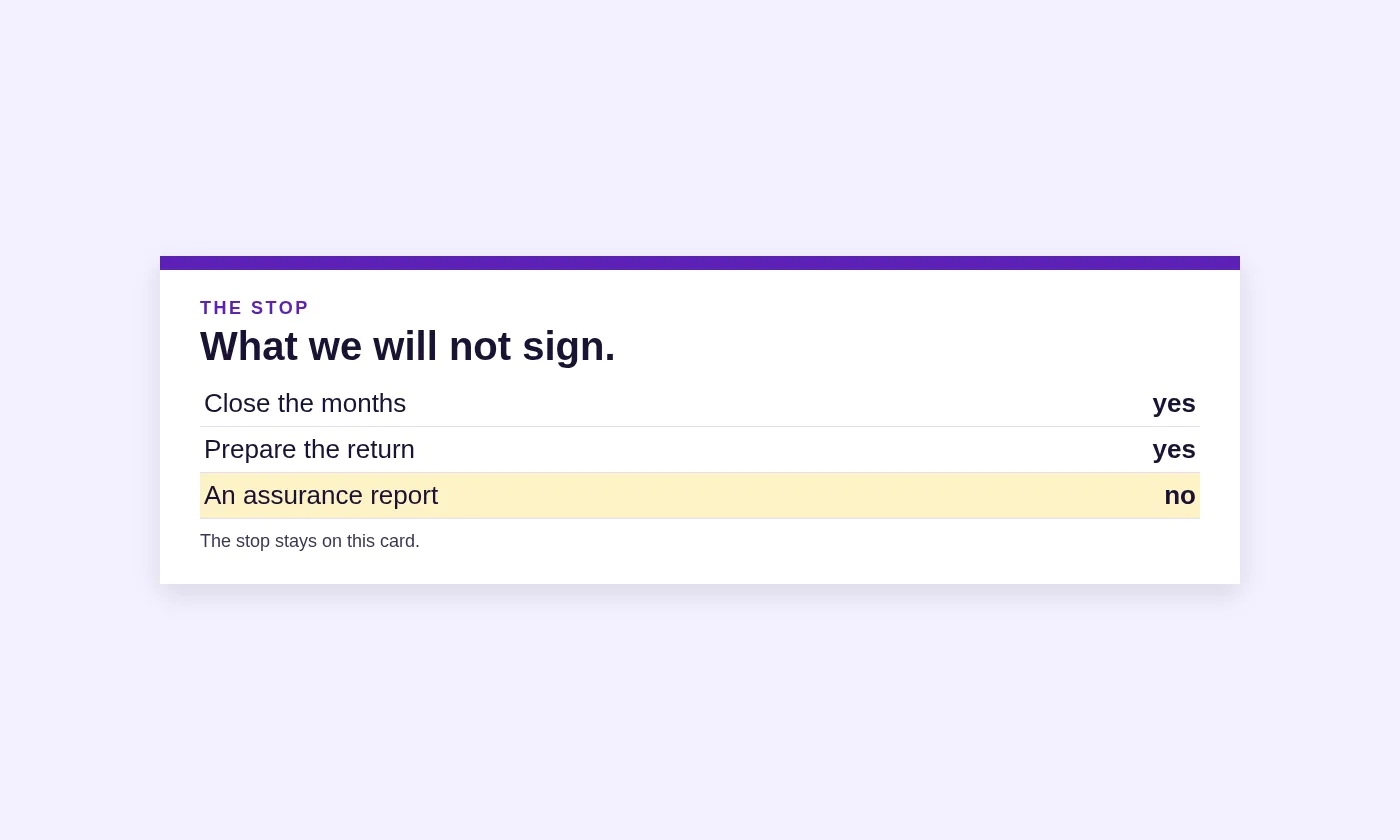
How a page is held, what the work refuses, and who publishes the address.
See the stop.Each page here is about one paper an owner can pick up. The acceptance letter. The acknowledgment that names a received day. A Schedule K-1 that might still be trapped in a portal. Wage forms that might disagree with the payroll register. The page tells you what that paper finishes, and which of the three proofs it leaves open.
Under every page, the footer carries one fixed note on how the pages are researched. That note stays word for word. The examples around it stay inside a company year. Form 2553, Form 1120-S, Schedule K-1, and the wage forms are the papers this address returns to.
A real client file is never printed. When a shop shows up, the same paragraph calls the shop invented. We skip savings figures. We skip a rate. We skip a count of how many times someone looked something up.
Figures without a named publishing office are thrown out during the writing pass. A statute section is cited only when that section actually helps the sentence. A rate recalled from a meeting, and nowhere written down, does not get a sentence here.
For a calendar-year company the ordinary return date is March 15, and the ordinary extended date is September 15. Both dates come from the federal calendar, so a shop in any state is looking at the same two days. This address will not teach that a Sunday becomes a new legal date. If March 15 lands on a Sunday, bring whatever acknowledgment you hold and we will name which paper it is.
A sample row, if one ever appears, is only the shape of a file. Copying it onto a real year would be a mistake.
Before a page stays, we hold it against three questions. Does the offer respect the stop further down this page. Does a story admit, in the same breath, that it was invented. Does the draft promise that this practice will cut paychecks. A yes on that last question throws the draft out.
If a draft stamps the same search words into paragraph after paragraph, that draft goes back in the pile. So does a draft that treats one software check as a finished year. So does a draft that renames a draw as wages while the wage forms are still missing.
Sentences around the stop can change. The stop itself stays where it was written. A writing pass is not allowed to slide it.
The repair happens on the page that is already up. The day a note names a bad figure, that figure comes off or a true one replaces it. Kinder adjectives do not stay behind as camouflage. The phone number at the bottom of the page is how that note arrives.
A repair stays on this address. The page people already opened is the page that changes. A fix is not moved to some other site and left for someone to hunt.
We are not a CPA. Nobody at this practice holds a CPA license. Signed assurance, the kind a lender means by an audit or a review or a compilation, belongs with a firm that can put a name on that report. We will say that before a scope is written down.
Payroll in this work is the setup conversation. Wage math, payroll returns, and the morning people are paid all stay with the provider the company already picked. Payday stays with that provider. The tax deposit stays there too.
If an examination notice arrives, we can stack the records. We do not take the chair for the company in that room. The person who speaks is named before that work starts.
What we still do is prepare the company return, talk through a year that has not closed, and hand over statements that carry no assurance.
The footer prints +1 844-324-7273.
Lead with the paper you are holding. Closed months and the return drawn from them fit in a single phone call. Steven Palmieri publishes these pages. The proof card leads with that name, then Tax CFO. People who already know the work often shorten the introduction to the Entrepreneur's CFO.
A house number is not printed. What the page shows is the whole public story. The data block under the hood repeats that story and adds no second set of facts. The voice on the page is we. The work is the practice.
Owners arrive holding different papers, so the practice keeps more than one public address. An acceptance letter and a wage register do not belong under a single headline. Every address rings the same practice.
One outbound link exists, and it goes to stevenpalmieri.com.
This site does not link sideways to another of our addresses. A lawyer still owns the company agreement. We can show which facts a form wants filled in. The company agreement stays with the lawyer who drafted it.
The acceptance letter, the acknowledgment, and the wage forms stay apart. The letter is what lets us treat the year as an S corporation year. The acknowledgment is the receipt for Form 1120-S. The wage forms are the record that pay was run for work the owner did. A green check on a software screen is none of those three.
Once the letter is real, wages for that work come before cash the owner takes out. Payroll, for us, is making the introduction to a provider the owner already picked. Payday is outside that piece. Contribution, distribution, and profit left in the company remain three lines.
A loss on the K-1 still meets a ceiling, and the ceiling is basis. People reach for Form 7203 when they want that ceiling written out as a worksheet. The worksheet is not reprinted here. The sentence we keep is that the loss waits when the ceiling is too low.
The company date is early so each owner can hold the K-1 before a personal return is due. A file that never left a portal misses that purpose. Owners on the list, then people actually holding the page. Those are the two counts.